
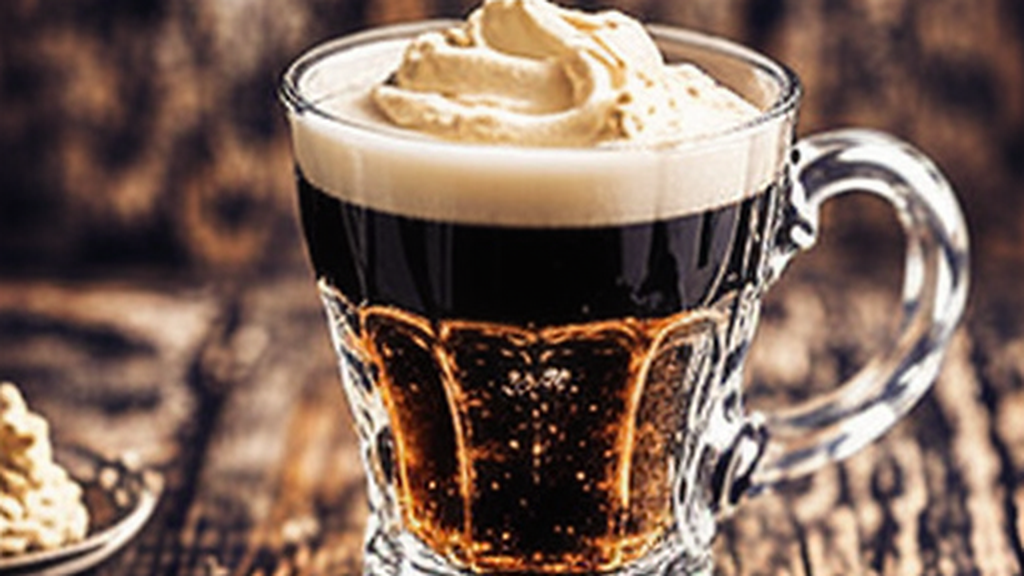
Irish coffee gets dressed up on cocktail menus with all kinds of additions, but the original — created in the 1940s at Foynes Port in Ireland to warm up cold, weary transatlantic flying-boat passengers — is just four ingredients done right. No coffee liqueur, no chocolate syrup, no whipped cream from a can. Here’s the real method.
The four ingredients
- Hot, strong black coffee — freshly brewed, not lukewarm leftovers.
- Irish whiskey — a smooth blended Irish whiskey like Jameson is the traditional choice; save peatier single malts for sipping neat.
- Brown sugar — dissolved into the hot coffee, which also helps the cream float on top.
- Lightly whipped heavy cream — barely whipped, poured gently over the back of a spoon so it floats rather than sinks.
The classic recipe
This makes one traditional Irish coffee, served in a stemmed glass or a clear glass mug so you can see the layers.
- Preheat your glass by filling it with hot water for a minute, then discarding the water. A cold glass will cool the coffee too fast and can crack from the thermal shock of hot liquid.
- Brew about 4 oz of strong hot coffee — a dark roast or a strong drip brew works well here. Pour it into the warmed glass.
- Stir in 1–2 teaspoons of brown sugar until fully dissolved. This step matters more than it seems: sugar increases the density of the coffee, which is part of what helps the cream layer float instead of sinking in.
- Add 1.5 oz (about a standard shot) of Irish whiskey and stir gently.
- In a separate bowl, whip about 2 oz of heavy cream lightly — you want it thickened and pourable, not stiff peaks like whipped topping for dessert. Over-whipped cream is too heavy to float properly.
- Pour the cream over the back of a spoon held just above the surface of the coffee, letting it spread and float on top rather than sinking in.
- Don’t stir after adding the cream. Drink it through the cream layer — that contrast between hot, boozy coffee underneath and cool cream on top is the entire point.
Why the cream floats (or doesn’t)
Three things determine whether your cream layer floats properly: the cream must be lightly whipped (not liquid, not stiff), the coffee underneath needs enough sugar to increase its density relative to the cream, and you need to pour slowly over the back of a spoon rather than dropping it straight in. Skip any one of these and the cream will sink and mix in — still tasty, but you lose the visual and textural layering that makes Irish coffee distinctive.
Choosing your coffee and whiskey
Use a coffee strong enough to stand up to whiskey and cream without disappearing — a dark roast brewed at the stronger end of our ratio chart, or straight from a French press, both work well. For whiskey, a smooth blended Irish whiskey is traditional because its lighter, sweeter profile doesn’t clash with the coffee and cream the way a heavily peated Scotch would.
Common mistakes
- Skipping the sugar. Beyond sweetness, it’s functionally necessary for the cream to float.
- Whipping the cream too stiff. Stiff peaks sit as a dense cap rather than a light floating layer, and it becomes harder to drink through.
- Using a cold glass. It cools the drink too quickly and risks cracking under hot liquid.
- Stirring after the cream goes on. Once it’s floating, leave it — stirring just turns it into a latte.
Serving size and variations
Traditional Irish coffee is a single-serving drink, not a big mug — the 4 oz coffee to 1.5 oz whiskey ratio is what keeps it balanced rather than diluted or overpoweringly boozy. If you want a lower-alcohol version, reduce the whiskey to 1 oz and add slightly more coffee. Some modern versions add a teaspoon of coffee liqueur alongside the whiskey for extra depth, though that departs from the original 1940s recipe.
The history behind the drink
Irish coffee was created in the 1940s by chef Joe Sheridan at the Foynes Port flying-boat terminal in County Limerick, Ireland, meant to warm and comfort cold, weary transatlantic passengers arriving after a long, rough flight. When a passenger asked if the coffee was Brazilian, Sheridan reportedly replied “No, that’s Irish coffee” — and the name stuck. The drink crossed the Atlantic in the 1950s after a San Francisco travel writer tracked down the recipe at Shannon Airport and helped popularize it at the Buena Vista Cafe, which still serves it today and claims to have introduced it to America.
Batch-friendly version for guests
If you’re serving a group, brew a large pot of strong coffee and pre-dissolve brown sugar into the whole pot rather than mixing it cup by cup — this keeps the ratio consistent across servings. Pour individual servings into preheated glasses, add whiskey to each one individually (since alcohol tolerance varies by guest), and whip a larger batch of cream just before serving so it’s fresh and pourable rather than sitting out and deflating. This lets you serve several guests within a couple of minutes of each other, which matters since Irish coffee is best enjoyed hot, right after assembly.
One more tip: always use fresh cream rather than anything ultra-pasteurized if you can find it. Fresh cream whips lighter and floats more reliably, while ultra-pasteurized cream can be stubborn to whip to the right consistency and sometimes sinks instead of holding its layer on top of the coffee.
Frequently asked questions
What’s the best whiskey for Irish coffee?
A smooth, mild blended Irish whiskey — Jameson is the standard choice for a reason. Save single malts and cask-strength whiskeys for drinking on their own, where their complexity won’t be muted by coffee and cream.
Can I make Irish coffee without alcohol?
Yes — simply omit the whiskey for a sweetened, cream-topped coffee. It won’t technically be “Irish coffee,” but it follows the same technique and tastes great on its own.
Do I need a special glass?
Not strictly, but a clear glass mug or stemmed glass lets you see the cream floating on top, which is part of the drink’s appeal. Any heatproof glass will function fine.